

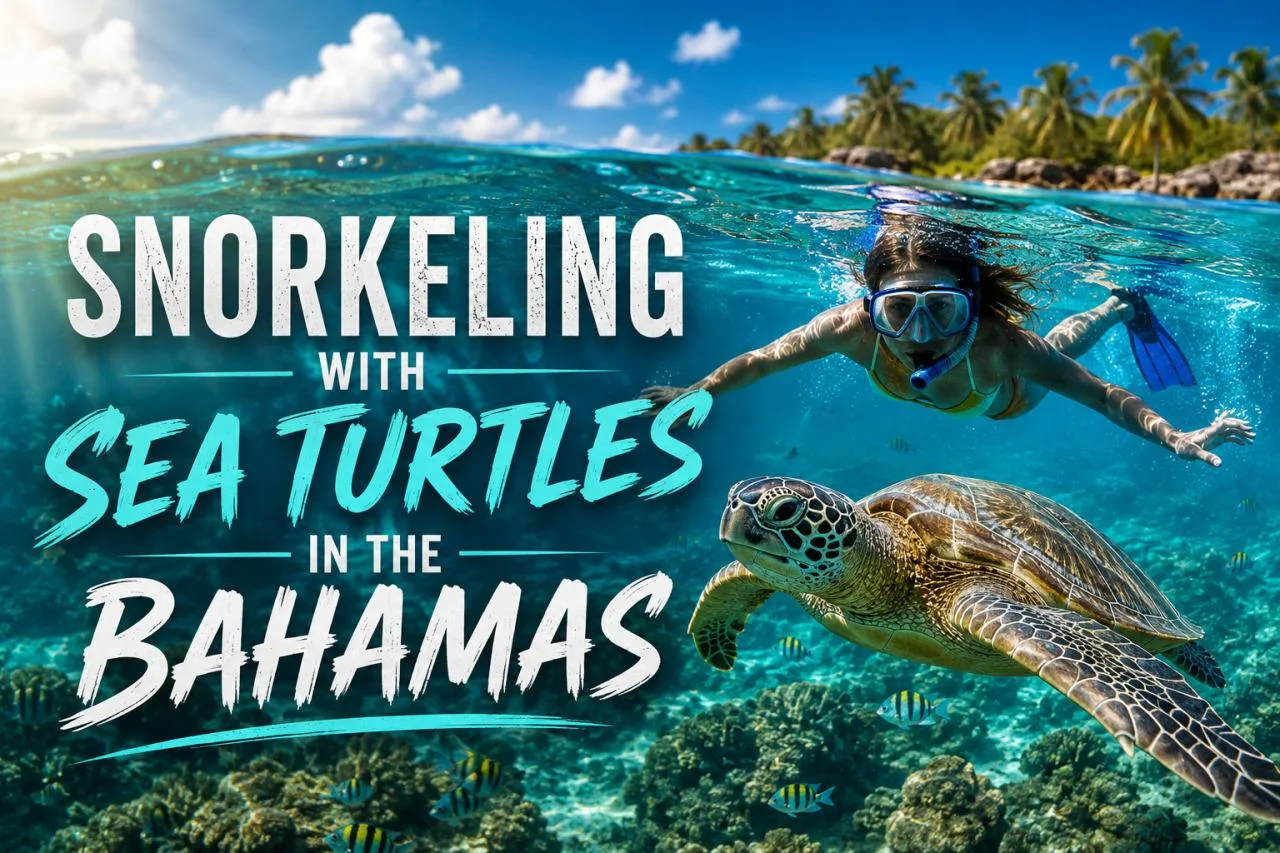
There are plenty of reasons travelers come to the Bahamas. Clear turquoise water, white-sand beaches, coral reefs, hidden coves, and hundreds of islands make the country one of the Caribbean region’s most recognizable tropical destinations.
But for many visitors, one experience stands above a typical afternoon at the beach: seeing a sea turtle swimming freely beneath the surface.
Unlike observing wildlife in an aquarium, encountering a turtle in its natural habitat is unpredictable. It might glide across a shallow seagrass bed, surface briefly for air, or disappear into deeper blue water before you have time to reach for your camera.
That unpredictability is precisely what makes the experience memorable.
Why the Bahamas Is Such a Good Place to See Sea Turtles
The Bahamas consists of hundreds of islands and cays surrounded by warm subtropical waters.
Its marine environments include:
- Coral reefs
- Seagrass beds
- Mangroves
- Shallow banks
- Sandy bottoms
- Protected coves
These habitats support an extraordinary variety of marine life.
Sea turtles are among the animals visitors may encounter while exploring Bahamian waters, particularly around areas with healthy seagrass and relatively calm conditions.
Which Sea Turtles Can You See in the Bahamas?
Several species of sea turtle occur in Bahamian waters, although sightings depend on location, season, habitat, and luck.
Two species travelers may commonly associate with snorkeling encounters are green turtles and hawksbill turtles.
Learning the basic differences between them can make an encounter even more interesting.
Green Sea Turtles
Green turtles are strongly associated with seagrass habitats.
You may encounter one moving slowly above a grassy seabed before lowering its head to feed.
Their calm movements can make them fascinating to observe from a respectful distance.
Despite their relaxed appearance, sea turtles are powerful swimmers and can move away quickly when they choose.
Hawksbill Turtles
Hawksbill turtles are often associated with reef environments.
They are named for their distinctive narrow, pointed beaks.
Their patterned shells can be striking underwater, particularly when sunlight filters through clear Bahamian water.
Seeing one moving around a reef can become a highlight of a snorkeling trip.
Why Seagrass Beds Matter
Some travelers imagine that the best snorkeling must always involve a dramatic coral reef.
That isn’t necessarily true when turtles are the objective.
Seagrass beds can be extremely important feeding areas.
From the surface, a grassy seabed may initially look less exciting than colorful coral. But look carefully and you may notice turtles, rays, fish, conchs, and other marine animals moving through the habitat.
The lesson is simple: don’t ignore the grass.
Turtle Encounters Are Different From Reef Snorkeling
Traditional reef snorkeling often involves looking at hundreds of small details.
You might move slowly over coral formations while watching colorful fish disappear between crevices.
Turtle snorkeling feels different.
A single animal can command everyone’s attention.
When a turtle appears, snorkelers often stop moving and simply watch.
That quiet observation can be more memorable than trying to cover a large area.
The First Sight Is Usually the Best Moment
You are floating at the surface.
There is sand below you, patches of seagrass, and perhaps a few fish.
Then something moves.
At first, it may look like a dark shape.
A second later, the shell becomes recognizable.
There is a turtle below you.
For many first-time snorkelers, that moment creates an immediate sense of excitement.
Turtles Look Surprisingly Graceful Underwater
Sea turtles can appear awkward when seen moving on land.
Underwater, everything changes.
Their flippers move almost like wings.
A few slow strokes can send them gliding through the water with remarkably little visible effort.
Watching that movement from above provides a completely different appreciation for an animal designed to spend most of its life at sea.
The Nassau Area Offers Convenient Access
Visitors staying in Nassau or arriving at the Nassau cruise port do not necessarily need to travel deep into the Out Islands to experience interesting marine environments.
New Providence is surrounded by smaller islands, reefs, cays, and shallow waters that can be reached by boat.
Depending on the itinerary and current conditions, excursions may explore areas associated with:
- Rose Island
- Green Cay
- Athol Island
- Nearby reefs
- Shallow snorkeling locations
The exact destination should depend on conditions rather than simply following a fixed route.
Green Cay Is Closely Associated With Turtle Sightings
Among visitors exploring waters near Nassau, Green Cay is particularly well known for the possibility of encountering sea turtles.
Its surrounding marine habitat can make it an appealing snorkeling destination when conditions are appropriate.
However, wildlife should never be treated as guaranteed.
A turtle is not waiting for an appointment.
The possibility of seeing one is part of the adventure.
Why Boat Access Makes a Difference
Some snorkeling can be done directly from beaches, but boats significantly expand the areas visitors can explore.
A boat can reach:
- Offshore reefs
- Smaller cays
- Seagrass areas
- Quieter snorkeling sites
- Locations inaccessible from shore
It also allows captains to adjust the itinerary according to wind, waves, visibility, and marine activity.
That flexibility can be particularly valuable around islands.
Private Trips Can Create a Different Experience
Large group excursions can be convenient, but private or small-group boat trips offer another style of snorkeling.
Instead of following a rigid schedule, a smaller group may have more flexibility regarding how long to remain at a particular location.
That can be helpful when:
- Turtles are active
- Visibility is excellent
- Children need additional time
- Beginners need instruction
- The group wants to explore another area
The objective becomes enjoying the environment rather than moving through a checklist.
What Snorkeling With a Turtle Actually Feels Like
The most memorable part of snorkeling with turtles bahamas is often how ordinary the turtle seems within its own environment. It isn’t performing for visitors. It may simply be feeding, swimming, resting, or surfacing for air while you happen to be nearby.
That is precisely why respectful observation matters.
The best encounter is one where the animal continues behaving naturally despite your presence.
Don’t Chase Sea Turtles
Seeing a turtle can make people excited.
The natural reaction is often to swim directly toward it.
Resist that instinct.
Chasing can cause the turtle to:
- Swim away
- Change direction
- Stop feeding
- Become stressed
Instead, remain calm and allow the encounter to develop naturally.
You may actually see more by doing less.
Never Touch a Sea Turtle
Sea turtles are wild animals.
Do not grab their shells, hold their flippers, block their path, or attempt to ride them.
Even if a turtle appears calm, touching it changes the interaction from observation to interference.
Keep your hands to yourself and enjoy the privilege of seeing the animal in its natural environment.
Give Turtles Room to Surface
Sea turtles breathe air.
That means they periodically need to reach the surface.
If a turtle begins swimming upward, do not surround it.
Move aside and give it an unobstructed path.
This becomes especially important when several snorkelers notice the same animal.
Everyone naturally wants a closer view, but crowding can create unnecessary pressure.
Don’t Surround the Animal
One turtle can quickly attract a circle of snorkelers.
Try to avoid creating that situation.
If people remain primarily on one side and maintain distance, the turtle has more freedom to choose where it wants to go.
Wildlife should always have an easy escape route.
Calm Swimming Produces Better Encounters
Aggressive kicking creates:
- Noise
- Bubbles
- Splashing
- Disturbed sediment
None of those things improve wildlife viewing.
Slow fin movements and relaxed breathing make snorkeling easier while creating less disturbance.
You also conserve energy, which is particularly useful during longer sessions.
Beginners Can Still Enjoy Turtle Snorkeling
You do not necessarily need to be an expert swimmer to enjoy snorkeling.
However, comfort in the water matters.
Beginners should:
- Tell the captain or guide about their experience level
- Use properly fitting equipment
- Consider flotation assistance
- Stay near the boat or guide
- Avoid conditions beyond their abilities
There is no prize for pretending to be more experienced than you are.
A Good Mask Changes Everything
A leaking mask can turn a beautiful snorkeling experience into an exercise in frustration.
The mask should create a comfortable seal around your face.
Before entering the water:
- Position the mask properly.
- Adjust the strap without overtightening.
- Make sure hair isn’t trapped beneath the seal.
- Test the fit.
A mask that works well allows you to focus on the turtle rather than repeatedly clearing water.
Practice Breathing Through the Snorkel
First-time snorkelers sometimes find breathing through a snorkel unnatural.
Practice in calm shallow water before heading toward the main snorkeling area.
Take slow, controlled breaths.
Once you become accustomed to the sensation, snorkeling becomes much more relaxing.
Fins Help You Move Efficiently
Fins allow snorkelers to cover distance without excessive effort.
But they should be used carefully.
Large, frantic kicks waste energy and can accidentally strike:
- Coral
- Other swimmers
- Marine life
Use slow movements from the hips and remain aware of what is behind you.
A Flotation Vest Can Increase Confidence
Even strong swimmers sometimes appreciate flotation support during snorkeling.
It allows you to spend more energy observing marine life and less energy maintaining your position at the surface.
For beginners or children, flotation can make the experience considerably more comfortable.
Use equipment appropriate to your ability and follow the guidance of the crew.
Water Clarity Can Be Remarkable
One reason snorkeling in the Bahamas can be so memorable is visibility.
On a calm, clear day, the water can feel almost transparent.
From the surface, you may be able to see:
- Seagrass
- Sand patterns
- Coral
- Fish
- Rays
- Turtles
well below you.
Conditions vary, however, and even beautiful tropical water is not perfectly clear every day.
Weather Matters More Than People Expect
A bright sky does not automatically mean ideal snorkeling.
Conditions can be affected by:
- Wind
- Waves
- Currents
- Recent storms
- Tides
- Cloud cover
A knowledgeable captain may change locations because another area offers safer or clearer conditions.
That flexibility should be viewed as good judgment rather than a disappointing itinerary change.
Morning Snorkeling Can Be Beautiful
Morning trips can offer pleasant conditions, particularly when winds are lighter.
The light can also make underwater visibility feel especially crisp.
However, there is no universal “perfect hour.”
Local conditions matter more than a general rule.
Sun Protection Is Essential
The water can make the Bahamian sun feel deceptively comfortable.
You may not realize how much exposure you are receiving while snorkeling.
Consider:
- Rash guards
- Sun-protective clothing
- Hats while on the boat
- Appropriate sunscreen
- Shade breaks
The back of the body receives substantial exposure while floating face-down.
Stay Hydrated
Snorkeling is physical activity.
Add tropical sun and boat travel, and dehydration can become a concern.
Drink water before and after entering the ocean.
If you are spending several hours on the water, continue hydrating throughout the trip.
Don’t Feed Turtles
Feeding wildlife can change natural behavior.
A turtle should associate its environment with naturally available food rather than people.
The best wildlife encounters happen because you found the animal living normally, not because food was used to attract it.
Photography Should Not Control the Experience
It is understandable to want photographs.
An underwater image of a sea turtle can become an incredible vacation memory.
But don’t spend the entire encounter looking through a screen.
Sometimes the better memory is simply watching.
Take a few photographs or short videos, then put the camera down and experience what is happening around you.
Underwater Cameras Need Good Light
Water absorbs light and color.
Even when visibility appears excellent to your eyes, underwater photographs can look different.
For better results:
- Keep the sun behind or above you when possible
- Stay steady
- Avoid excessive digital zoom
- Let the turtle enter the frame naturally
- Take short video clips
Do not chase wildlife simply to improve a photograph.
Wide-Angle Images Can Tell a Better Story
A close-up shell photograph is impressive, but wider images can show the turtle within the Bahamian environment.
Including:
- Blue water
- Seagrass
- Reef
- Sunlight
can create a stronger sense of place.
The environment is part of the encounter.
Sea Turtles Are Only Part of the Experience
While looking for turtles, keep watching the surrounding water.
Depending on the location, you may encounter:
- Tropical fish
- Rays
- Conchs
- Starfish
- Coral formations
- Other marine animals
Sometimes the unexpected sightings become just as memorable as the animal you originally hoped to see.
Rays Can Be Easy to Miss
Rays often blend remarkably well with sandy bottoms.
A shape that appears to be part of the seabed may suddenly begin moving.
Give rays space just as you would any other wildlife.
There is no reason to approach closely.
Coral Reefs Add Another Dimension
If the excursion includes a reef stop, the experience changes dramatically.
Instead of focusing on a single large animal, you may find yourself observing dozens of species at once.
Reefs can contain:
- Small reef fish
- Larger fish
- Sponges
- Corals
- Invertebrates
Move slowly and avoid touching anything.
Never Stand on Coral
Coral may look like rock.
It isn’t.
Living coral can be damaged by physical contact.
If you need to rest, use flotation support or return to the boat rather than standing on a reef.
Good snorkeling leaves the environment exactly as you found it.
Don’t Take Marine Life Home
Shells, coral, starfish, and other marine organisms belong in the ecosystem.
Even objects that appear empty can serve ecological functions.
The best souvenir is a photograph.
Leave natural materials where they are unless you are certain collection is lawful and environmentally appropriate.
Children Often Love Turtle Encounters
For families, seeing a sea turtle can be an unforgettable introduction to marine wildlife.
Children who initially feel uncertain about snorkeling may become completely focused once they spot an animal below.
Parents should still consider:
- Swimming ability
- Comfort with masks
- Water conditions
- Flotation
- Supervision
A short, positive snorkeling session is better than forcing a nervous child to stay in the water.
Let Children Practice Before the Excursion
If possible, let younger snorkelers practice using a mask and snorkel before the trip.
A swimming pool or calm shallow beach can help them become comfortable with:
- Breathing
- Mask fit
- Floating
- Fin movement
Learning these basics beforehand means they can focus on wildlife during the actual excursion.
Adults Can Be Nervous Too
Snorkeling anxiety is not limited to children.
Some adults are uncomfortable with:
- Deep water
- Boats
- Marine animals
- Breathing through a snorkel
Tell the crew.
Experienced guides would rather know that someone is nervous than discover it after they are already in the water.
You Don’t Have to Dive Down
Some experienced snorkelers enjoy freediving beneath the surface.
It isn’t necessary.
Sea turtles can often be observed perfectly well while floating above them.
Remaining at the surface is also easier for beginners and reduces the temptation to approach wildlife too closely.
The Turtle May Come Closer on Its Own
One of the most exciting moments occurs when a turtle chooses to swim in your direction.
Stay calm.
There is no need to reach toward it.
Let the animal determine the distance.
A voluntary wildlife encounter is much more meaningful than one created by pursuit.
Every Turtle Encounter Is Different
One turtle might remain visible for several minutes.
Another may disappear almost immediately.
You might see several turtles during one excursion and none during another.
That variability is part of observing wild animals.
A responsible tour should never promise a guaranteed interaction with a specific animal.
Why Wildlife Guarantees Should Be Viewed Carefully
Tourism advertising sometimes creates unrealistic expectations.
Wild animals move according to:
- Food
- Water conditions
- Disturbance
- Weather
- Natural behavior
No responsible operator controls those factors completely.
Look for experiences that emphasize respectful observation rather than guaranteed contact.
Choose the Experience, Not Just the Turtle
If your entire trip depends on one specific wildlife sighting, disappointment becomes more likely.
Instead, think about the broader day.
A good boat excursion might include:
- Snorkeling
- Island scenery
- Beaches
- Reef exploration
- Swimming
- Wildlife observation
Then a turtle encounter becomes an extraordinary highlight rather than the only measure of whether the trip was successful.
Rose Island Can Be Part of a Broader Day
Rose Island is a popular destination for visitors exploring waters outside Nassau.
Its beaches and surrounding areas can fit naturally into a day involving swimming, snorkeling, and island exploration.
A flexible itinerary may combine multiple experiences rather than spending the entire excursion in one place.
Green Cay and Rose Island Offer Different Experiences
Travelers sometimes treat nearby islands as interchangeable.
They aren’t.
One location may be more interesting for wildlife, while another may be better suited to relaxing on a beach or enjoying shallow water.
Combining different environments can make a boat day more varied.
Snorkeling Is Better When It Isn’t Rushed
Imagine finally finding a turtle and immediately hearing that everyone needs to return to the boat.
Not ideal.
Wildlife observation benefits from patience.
Small-group and private experiences can sometimes provide greater flexibility, although conditions and schedules still matter.
Allow enough time to actually observe the environment.
Listen to the Captain
Local captains spend far more time on the water than most visitors.
They understand how conditions change around:
- Cays
- Reefs
- Channels
- Shallow banks
If a captain recommends skipping a particular snorkeling site because of wind or current, listen.
The most famous location is not necessarily the best location that particular day.
Safety Comes Before the Itinerary
Weather can change.
Water conditions can change.
An itinerary should never be treated as more important than safety.
If a snorkeling location becomes unsuitable, moving somewhere calmer is the correct decision.
The Bahamas provides enough beautiful water that alternative locations can still create an excellent day.
Seasickness Is Worth Considering
Even people who feel fine on large cruise ships can become uncomfortable on smaller boats.
If you are prone to motion sickness, prepare appropriately before the excursion.
Strategies may include:
- Eating a light meal
- Staying hydrated
- Looking toward the horizon
- Getting fresh air
Consult a medical professional or pharmacist about medication if necessary.
Bring Only What You Need
For a turtle snorkeling trip, useful items may include:
- Swimsuit
- Towel
- Sun protection
- Water
- Waterproof camera
- Dry bag
- Sunglasses
- Change of clothes
Avoid bringing unnecessary valuables onto the boat.
Saltwater and electronics are not always good friends.
Check What Equipment Is Included
Before booking, ask whether the excursion provides:
- Masks
- Snorkels
- Fins
- Flotation devices
If you own snorkeling equipment that fits you well, bringing it may improve comfort.
Otherwise, properly maintained rental equipment is common on organized excursions.
Prescription Masks May Be Worth Considering
Travelers who normally wear glasses can struggle to see underwater without correction.
Prescription snorkeling masks are available.
If clear underwater vision matters to you, arranging appropriate equipment beforehand can make a dramatic difference.
Seeing a blurry green shape is not quite the same as clearly seeing your first sea turtle.
What to Look for When Searching for Turtles
Rather than constantly scanning the distant horizon underwater, look carefully at the habitat beneath you.
Watch for:
- Rounded shell shapes
- Movement over seagrass
- Turtles resting near structure
- Animals surfacing for air
Sometimes a turtle is obvious.
Other times it blends surprisingly well with the bottom.
Watch Other Snorkelers
You can often tell when someone has spotted something.
A group suddenly stops swimming.
Someone points.
Everyone turns in the same direction.
That may indicate a turtle, ray, or other interesting marine animal.
Approach calmly rather than racing toward the group.
Keep Your Head Underwater
It sounds obvious, but beginners often spend a surprising amount of time lifting their heads.
Once comfortable with the snorkel, keep your face in the water and scan slowly.
Marine life can appear and disappear quickly.
The more time you spend looking below, the more you are likely to notice.
Don’t Forget to Look Behind You
Everyone naturally swims in the same direction.
Wildlife doesn’t.
Occasionally look around rather than focusing exclusively ahead.
A turtle may surface behind the group while everyone else is staring at an empty patch of seagrass.
Respect Other Snorkelers
If someone spots a turtle first, don’t swim directly over them.
Give people room.
Avoid kicking near another person’s mask or camera.
A good wildlife encounter can accommodate multiple observers when everyone behaves calmly.
Conservation Makes Future Encounters Possible
Sea turtles face numerous threats throughout their lives.
Responsible tourism cannot solve every conservation problem, but visitor behavior still matters.
Simple actions help:
- Don’t touch wildlife
- Don’t feed wildlife
- Avoid littering
- Reduce unnecessary plastic waste
- Respect marine habitats
- Follow local regulations
Tourism and conservation work best when seeing wildlife creates greater appreciation for protecting it.
The Bahamas Is More Than a Backdrop
It is easy to treat turquoise water as scenery for vacation photographs.
But the ocean is a living ecosystem.
Seagrass, coral, mangroves, fish, turtles, and countless smaller organisms are interconnected.
Understanding that relationship can transform snorkeling from entertainment into something more meaningful.
Why Turtle Snorkeling Stays With People
People take hundreds of vacation photographs.
Many are forgotten.
Wildlife encounters tend to remain vivid.
You remember the moment the turtle appeared.
You remember how slowly it moved.
You remember watching it surface.
You remember realizing that you were sharing the water with an animal that had been navigating the ocean long before your boat arrived.
That feeling is difficult to reproduce anywhere else.
A Sample Turtle Snorkeling Day From Nassau
A relaxed excursion might unfold like this:
Morning departure from Nassau
Meet the captain, review safety information, and organize snorkeling equipment.
Cruise toward the cays
Enjoy views of Nassau and surrounding turquoise water.
First snorkeling stop
Explore a seagrass or reef environment where marine life may be present.
Wildlife observation
If turtles appear, remain calm and observe from a respectful distance.
Second destination
Visit another reef, cay, or beach depending on conditions.
Beach time
Swim, relax, or enjoy the shoreline.
Return to Nassau
Cruise back after several hours on the water.
The exact itinerary should remain flexible because weather and wildlife are never completely predictable.
Questions to Ask Before Booking
Before choosing a snorkeling excursion, consider asking:
- How large is the group?
- Is snorkeling equipment included?
- Are flotation devices available?
- Is the trip appropriate for beginners?
- How long is spent snorkeling?
- What happens if weather affects the planned location?
- Are children permitted?
- Does the itinerary include reef or beach stops?
- What wildlife practices does the operator follow?
The answers can tell you considerably more than promotional photographs alone.
FAQs
Can you snorkel with sea turtles in the Bahamas?
Yes, sea turtles inhabit Bahamian waters and may be encountered while snorkeling in appropriate marine habitats. Sightings are never guaranteed because the turtles are wild animals.
Where can I see turtles near Nassau?
Areas around smaller cays near New Providence, including Green Cay and other suitable marine habitats, are associated with possible turtle sightings. Actual locations should depend on current conditions and responsible local guidance.
Do I need to be an experienced swimmer?
Not necessarily, although basic water confidence is important. Beginners should inform the guide, use appropriate flotation when needed, and remain within their abilities.
Can I touch a sea turtle?
No. Observe turtles without touching, chasing, feeding, surrounding, or interfering with them.
What should I bring for turtle snorkeling?
Typical items include swimwear, a towel, sun protection, drinking water, sunglasses, and an underwater camera if desired. Check whether snorkeling equipment and flotation devices are included with your excursion.
Are sea turtle sightings guaranteed?
No. Sea turtles are wild animals, and their location and behavior can change. Responsible wildlife experiences should focus on the opportunity to observe turtles rather than promising guaranteed encounters.
Final Thoughts
Seeing a sea turtle in the Bahamas is memorable precisely because the encounter belongs to the animal, not the visitor.
You enter the water without knowing exactly what you will find.
Then a shell appears above the seagrass.
A turtle moves slowly beneath you, rises toward the surface for a breath, and disappears again into the blue.
There is no stage, no enclosure, and no scheduled performance.
That is the experience.
The best way to enjoy it is also the simplest: swim calmly, keep your distance, respect the habitat, listen to local guidance, and allow the turtle to behave naturally.
Even if the encounter lasts only a few minutes, it can completely change the way you remember a day on the water.
The beaches of the Bahamas are beautiful from shore, but sometimes the most unforgettable part of the islands begins the moment you put your face beneath the surface.