

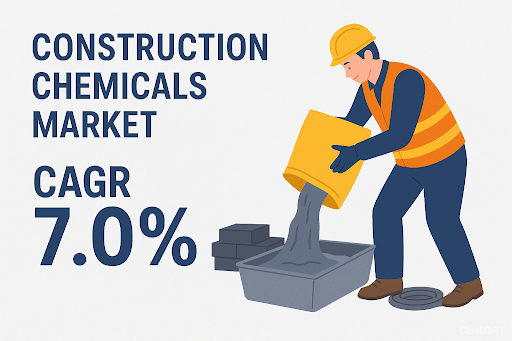
Imagine a world where our buildings heal their own cracks, concrete repels water and stains, and skyscrapers withstand earthquakes with unprecedented resilience. This isn’t science fiction; it’s the rapidly evolving reality driven by the dynamic construction chemicals industry. Recent market analysis reveals a staggering trajectory: from a robust USD 58.4 billion in 2023, the global construction chemicals market is projected to soar to USD 107.1 billion by 2032, growing at a compelling Compound Annual Growth Rate (CAGR) of 7.0%.
These numbers are more than just statistics; they are a testament to a fundamental shift in how we build, maintain, and think about our infrastructure. So, what powerful forces are fueling this multi-billion-dollar expansion? Let’s delve into the key drivers, emerging trends, and future implications shaping the very foundations of our constructed world.
The Pillars of Growth: Deconstructing the Market Surge
The impressive growth of the construction chemicals market rests on several interconnected pillars, each contributing to the steady 7.0% CAGR.
1. The Global Infrastructure Boom
From the ambitious Belt and Road Initiative in Asia to massive infrastructure bills in North America and Europe, governments worldwide are investing heavily in public works. Airports, bridges, tunnels, highways, and rail networks are being constructed at a feverish pace. In these megaprojects, performance is non-negotiable. Construction chemicals—including high-performance concrete admixtures, waterproofing agents, and soil stabilizers—are essential for ensuring the durability, longevity, and safety of these critical assets, protecting the massive public and private investments behind them.
2. The Urbanization Juggernaut
The global migration to cities shows no signs of slowing. The United Nations estimates that over two-thirds of the world’s population will live in urban areas by 2050. This relentless urbanization demands the construction of high-rise residential complexes, commercial spaces, and supporting utilities. In dense urban environments, where space is at a premium and construction timelines are tight, chemicals that allow for faster curing times, improve strength-to-weight ratios, and enable innovative architectural designs are not just beneficial—they are indispensable.
3. The Rising Demand for Repair and Rehabilitation
While new construction is a major driver, a significant portion of the market is dedicated to maintaining and upgrading our existing infrastructure. Much of the world’s built environment is aging. Bridges are corroding, concrete is spalling, and buildings are becoming energy-inefficient. This has created a massive market for rehabilitation chemicals, such as epoxy injection resins for crack repair, protective coatings for rust prevention, and structural strengthening composites. This trend emphasizes a shift from pure new-build to a more sustainable model of preservation and renewal.
4. The Green Building Revolution
Perhaps the most transformative driver is the global push for sustainability. The construction industry is a major consumer of energy and a significant contributor to carbon emissions. This has catalyzed the green building movement, championed by certifications like LEED and BREEAM. Construction chemicals are at the heart of this revolution:
- Energy Efficiency: Advanced insulation foams and reflective roof coatings drastically reduce a building’s heating and cooling loads.
- Sustainable Materials: Water-reducing admixtures cut down the water content in concrete, while other additives allow for the use of industrial by-products like fly ash, reducing the carbon footprint.
- Durability and Resource Conservation: Longer-lasting structures mean less frequent reconstruction and, therefore, lower consumption of raw materials over the long term.
Key Product Segments Leading the Charge
Within the broad market, several product categories are experiencing particularly strong demand:
- Concrete Admixtures: The undisputed king of the market, these chemicals are added to concrete before or during mixing to enhance its properties—increasing workability, accelerating or retarding setting time, and improving strength and durability.
- Waterproofing Chemicals: Crucial for protecting structures from water damage, a primary cause of decay. This segment includes membranes, coatings, and integral waterproofing compounds used in basements, roofs, and water-retaining structures.
- Adhesives and Sealants: The demand for high-performance, durable, and flexible adhesives for tiles, panels, and flooring is booming, driven by both new construction and renovation.
- Protective Coatings: These coatings shield structures from environmental aggressors like UV radiation, chemical attack, and abrasion, significantly extending their service life.
Regional Hotspots: Where is the Growth Concentrated?
The growth is not uniform across the globe. The Asia-Pacific region is, and will continue to be, the dominant force, accounting for the largest market share. This is fueled by the explosive economic growth and massive infrastructure projects in China and India, alongside rapid development in Southeast Asian nations. North America and Europe remain significant markets, characterized by a strong focus on infrastructure repair, stringent building codes, and high adoption of green building technologies. The Middle East is another key region, with its continuous investment in iconic, large-scale commercial and residential projects.
The Future is Formulated: Emerging Trends to Watch
As we look toward 2032 and beyond, several exciting trends will shape the market:
- Smart and Functional Chemicals: The next frontier involves chemicals that do more than just protect. We are seeing the development of self-healing concrete that uses bacteria to seal micro-cracks, photocatalytic coatings that break down air pollutants, and phase-change materials that regulate indoor temperatures.
- Digitalization and Industry 4.0: The integration of digital tools is optimizing the use of construction chemicals. Sensors can monitor concrete strength in real-time, and BIM (Building Information Modeling) software can precisely calculate the required quantities of chemicals, minimizing waste.
- Bio-based and Circular Solutions: The demand for sustainable products will intensify, pushing manufacturers to develop plant-based, non-toxic, and biodegradable chemical solutions, as well as formulations that support the use of recycled materials.
Conclusion: Building a Stronger, Smarter, and More Sustainable World
The projected journey from USD 58.4 billion to USD 107.1 billion is a clear indicator that the construction industry is undergoing a profound transformation. Construction chemicals have evolved from being niche additives to fundamental components of modern engineering. They are the silent partners enabling us to build taller, safer, and more sustainable structures that can withstand the tests of time and nature.
This growth story is not just about market value; it’s about value creation for our society. It’s about creating resilient cities, conserving precious resources, and leaving a legacy of durable, intelligent infrastructure for future generations. As the industry continues to innovate, one thing is certain: the future of construction is not just built with brick and steel, but with sophisticated chemistry that is redefining the possible.